
LLC vs C-Corp: Which US Entity Is Right for You?
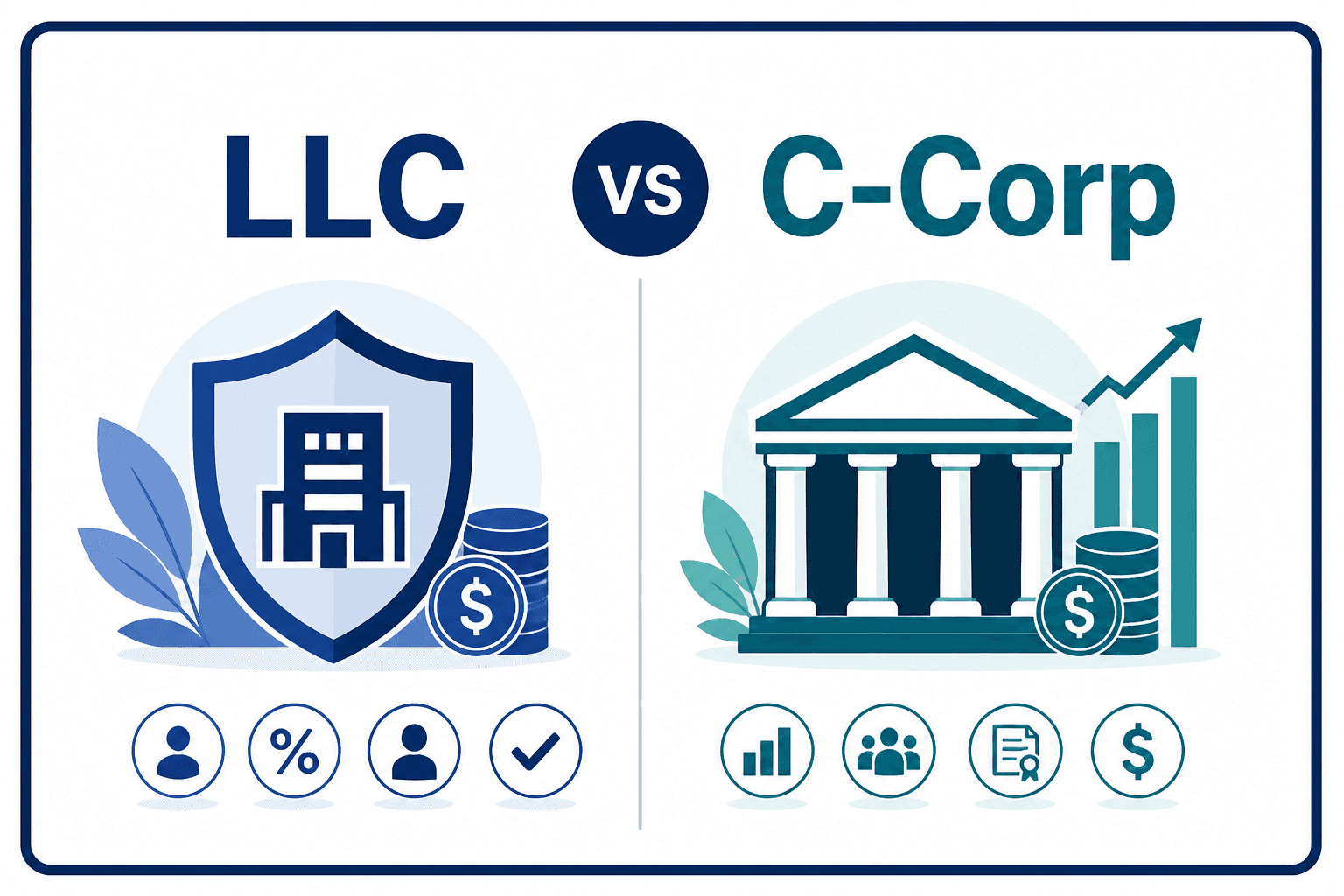
You've decided to build something in the United States — congratulations. Now comes one of the first real decisions that will shape your company's future: should you form a Limited Liability Company (LLC) or a C-Corporation (C-Corp)? For first-time founders, operators, and international entrepreneurs, the choice can feel overwhelming. Both structures offer liability protection and legitimacy, but they differ significantly in how they're taxed, governed, and financed. Getting this decision right from the start can save you thousands of dollars, years of restructuring headaches, and a lot of uncomfortable conversations with investors.
What Is an LLC?
A Limited Liability Company is a flexible business structure that blends elements of a partnership and a corporation. Owners of an LLC are called members, and the company is typically governed by an operating agreement rather than corporate bylaws. LLCs are popular with small businesses, freelancers, family offices, and operators who want simplicity and tax efficiency without the overhead of a full corporate structure.
One of the biggest draws of an LLC is pass-through taxation. By default, the IRS does not tax the LLC itself as a separate entity. Instead, profits and losses flow directly through to the members' personal tax returns. This avoids the double taxation that can affect C-Corps and keeps accounting relatively straightforward.
If you're weighing specific state options, it's worth exploring a Wyoming LLC or a Delaware LLC — two of the most popular choices for founders due to their business-friendly laws and strong privacy protections.
What Is a C-Corp?
A C-Corporation is the standard corporate structure in the United States and the dominant choice for venture-backed startups. Owners are called shareholders, and the company is governed by a board of directors, corporate officers, and a formal set of bylaws. C-Corps can issue multiple classes of stock — including preferred shares — making them highly attractive to institutional investors and venture capital firms.
Unlike an LLC, a C-Corp is taxed as a separate legal entity. This means the corporation pays corporate income tax on its profits, and shareholders pay personal income tax again when those profits are distributed as dividends — the so-called double taxation problem. However, in practice, most early-stage startups reinvest profits rather than distributing them, which mitigates this concern considerably.
Delaware is by far the most common state for C-Corp formation, thanks to its well-established corporate law and Chancery Court system. You can explore the Delaware C-Corp structure in detail, or consider the increasingly popular Wyoming C-Corp as a cost-effective alternative.
Key Differences at a Glance
Taxation: LLCs use pass-through taxation by default; C-Corps are taxed at the entity level (currently 21% federal corporate rate), with potential double taxation on dividends.
Ownership: LLCs have members with flexible ownership percentages; C-Corps have shareholders with stock-based ownership, enabling multiple share classes.
Governance: LLCs are managed via an operating agreement with minimal formality; C-Corps require a board of directors, annual meetings, and formal corporate records.
Fundraising: C-Corps can issue preferred stock, making them the preferred vehicle for VC investment. LLCs can accept investment but are structurally less compatible with institutional capital.
Self-employment tax: LLC members who are active in the business typically pay self-employment tax on their share of profits. C-Corp owner-employees can split income between salary and dividends more tax-efficiently.
Equity compensation: C-Corps can issue options and restricted stock units (RSUs) via standard employee equity plans (such as ISOs). LLCs can offer profit interests but the mechanics are more complex.
When an LLC Makes More Sense
An LLC is often the right call when you're building a business that doesn't plan to raise traditional venture capital, values simplicity in governance, or where the owners want profits to flow directly to them with minimal corporate-level tax friction. Common use cases include:
Consultancies, agencies, and professional services firms
Real estate holding companies and family offices
Small e-commerce businesses and lifestyle brands
Operators who want asset protection without the overhead of a corporation
International founders who want a US presence without complex corporate governance
It's also worth noting that LLCs offer considerable flexibility in how they're structured and managed — something that appeals strongly to operators running lean teams. You can explore how different use cases map to the right entity type on the Entity Engine platform.
When a C-Corp Makes More Sense
A C-Corp is almost always the right structure if you're planning to raise venture capital, offer equity to employees, or eventually pursue an IPO or acquisition. Investors — particularly institutional ones — strongly prefer C-Corps because of the clean cap table mechanics, preferred stock provisions, and the well-understood legal framework they offer. Key scenarios where a C-Corp wins:
Startups actively seeking seed, Series A, or later-stage VC funding
Companies that want to offer standard employee stock option plans (ESOPs)
Businesses planning an IPO or a strategic acquisition
SaaS and technology companies building for scale
Companies that need to bring on co-founders and early employees with equity
Many web3 and technology founders also find the C-Corp structure useful when building products that interact with traditional finance or institutional markets. If you're in the crypto or blockchain space, it's worth reviewing how web3 entities are structured and whether a US entity is the right anchor for your project.
The Delaware Question
If you decide to go with a C-Corp, there's one more choice to make: which state? Delaware dominates for good reason. Its Court of Chancery specialises in corporate law, its statutes are the most developed in the country, and the vast majority of VC term sheets are written with a Delaware C-Corp assumption baked in. Most top-tier law firms and investors are intimately familiar with Delaware corporate law, which reduces friction and legal costs.
Wyoming has emerged as a strong alternative — particularly for founders who prioritise privacy and lower annual fees. The Wyoming C-Corp offers solid liability protection and a more founder-friendly fee structure, though it carries less institutional recognition than Delaware. For LLCs, both New York and Florida are common choices depending on where you operate.
Can You Convert Later?
Yes — and many companies do. It's relatively common for businesses to start as an LLC and later convert to a C-Corp when they begin fundraising. The conversion process is manageable but it's not free: it involves legal costs, potential tax considerations, and the administrative work of establishing proper corporate records. Converting early — before significant complexity accumulates — is always easier than doing it after years of LLC operating history. If you suspect you'll need VC funding within two to three years, it's often cleaner to start as a C-Corp from day one.
Making the Right Call
The LLC versus C-Corp decision ultimately comes down to three questions: How do you plan to fund the business? How do you want profits to flow? And how much governance overhead are you willing to manage? For lean, bootstrapped operators, the LLC wins on simplicity and tax efficiency. For founders building for institutional capital and scale, the C-Corp — almost always in Delaware — is the standard for a reason.
If you're still unsure which structure suits your situation, Entity Engine makes it straightforward to compare, incorporate, and manage US entities across multiple states and structures — without needing a law degree to get started. Explore our full range of supported jurisdictions and find the right fit for your goals.