
Top 3 Offshore Jurisdictions for Holding Companies: Pros & Cons
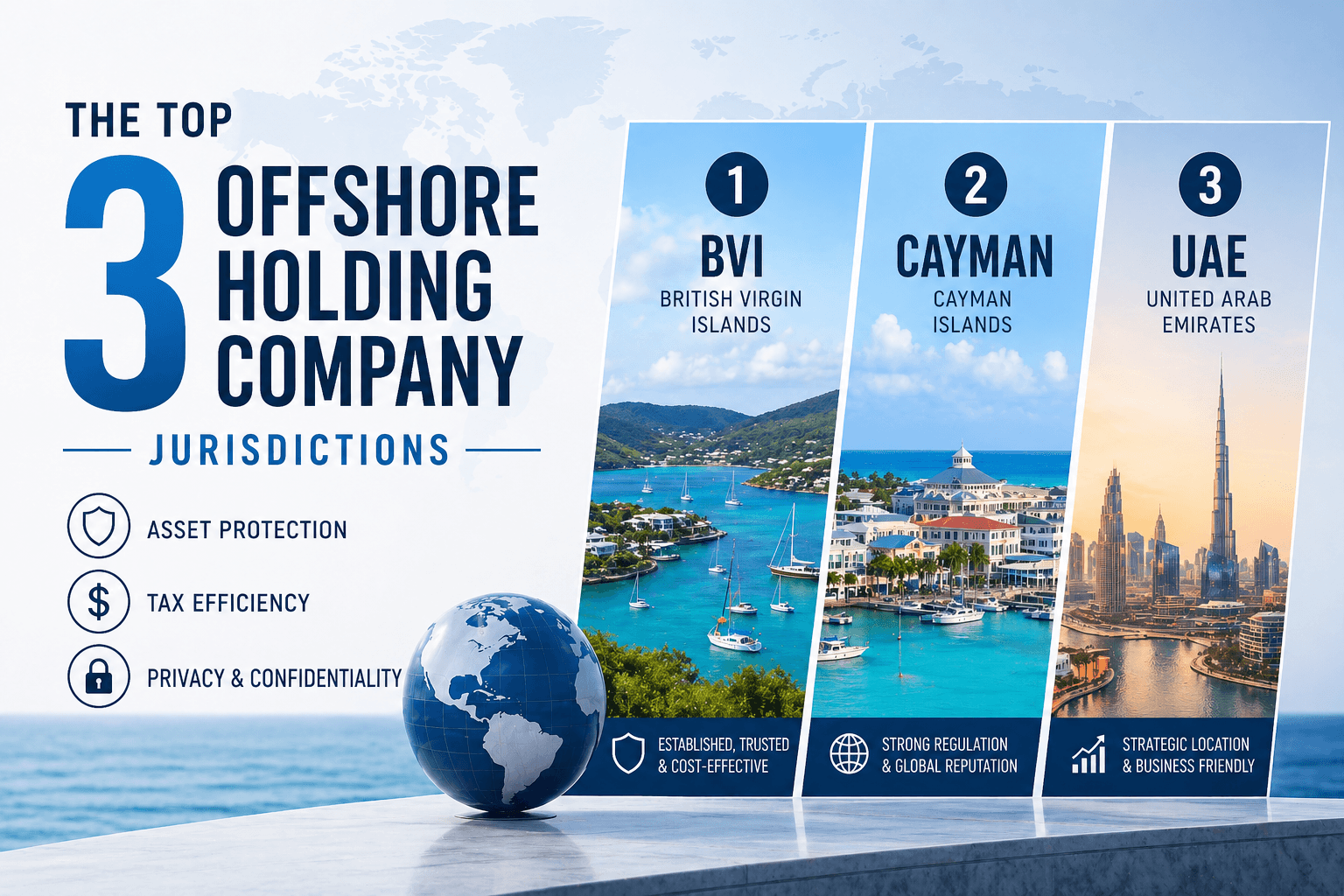
For founders, family offices, and international operators, the choice of where to incorporate an offshore holding company is one of the highest-leverage decisions in any corporate structure. Get it right, and you gain tax efficiency, asset protection, and operational flexibility across borders. Get it wrong, and you face regulatory headaches, banking friction, and structures that collapse under scrutiny. The problem is that the landscape is vast, the terminology opaque, and the advice often coloured by whoever is selling the service. This guide cuts through that noise and delivers an honest comparison of the three most popular offshore jurisdictions for holding companies: the British Virgin Islands (BVI), the Cayman Islands, and the UAE.
What Is an Offshore Holding Company and Why Does It Matter?
An offshore holding company is a legal entity incorporated in a jurisdiction outside your country of residence or primary business operations, used to own shares in subsidiary companies, hold intellectual property, manage investments, or consolidate group assets. The primary reasons operators establish offshore holding structures include:
Tax efficiency — holding dividends, capital gains, or royalties in a low- or zero-tax jurisdiction
Asset protection — insulating wealth from litigation, creditors, or political risk in higher-risk markets
Structural flexibility — enabling clean cap tables for investors, facilitating M&A activity, and simplifying cross-border ownership
Succession planning — particularly relevant for family offices managing multigenerational wealth
Privacy — many offshore jurisdictions maintain limited public registers of beneficial ownership
The right jurisdiction depends on your specific use case. Explore the full range of supported jurisdictions on Entity Engine to understand what each one offers before making a decision.
1. British Virgin Islands (BVI)
The BVI is arguably the world's most widely used offshore holding jurisdiction, with over 400,000 active companies registered on the islands. It is the default choice for many venture-backed startups, crypto projects, and international trading structures — and for good reason.
Pros
Zero corporate tax, capital gains tax, and withholding tax on income generated outside the BVI
Highly flexible company law — BVI Business Companies can issue shares with or without par value, in any currency, in any class structure
No requirement for public disclosure of directors or shareholders on a public register
Low annual government fees — typically USD 450–550 per year depending on authorised share capital
Widely recognised by banks, investors, and counterparties globally, making banking and fundraising more straightforward than more exotic jurisdictions
Established legal system based on English common law, with a dedicated Commercial Court
Cons
Economic Substance requirements introduced in 2019 mean that BVI companies carrying on certain "relevant activities" (such as holding company business, finance and leasing, or fund management) must demonstrate adequate substance in the BVI or face penalties
Banking is increasingly difficult — correspondent banking de-risking has made it harder to open accounts for pure BVI holding companies without additional substance or a credible operating business
Reputational perception — some counterparties, particularly in Europe, view BVI structures with scepticism given historical associations with tax avoidance schemes
Limited double tax treaty network — the BVI has no meaningful tax treaty network, which can create withholding tax inefficiencies when receiving dividends from treaty-sensitive jurisdictions
The BVI Limited Company remains one of the most cost-effective and structurally clean offshore vehicles available, particularly as a top-tier holding entity above operating subsidiaries in higher-substance jurisdictions.
2. Cayman Islands
The Cayman Islands is the jurisdiction of choice for institutional capital — hedge funds, private equity vehicles, venture capital funds, and large family office structures. If BVI is the workhorse of international commerce, Cayman is the thoroughbred of sophisticated finance.
Pros
Zero direct taxation — no income tax, corporate tax, capital gains tax, or inheritance tax, with statutory guarantees through 2036
Sophisticated regulatory environment — CIMA (Cayman Islands Monetary Authority) is internationally respected, making Cayman structures credible with institutional LPs, prime brokers, and tier-one banks
Exempted Companies are ideal holding vehicles — they can have a single shareholder, no minimum capital requirement, and are not subject to exchange controls
Foundation Companies are increasingly used for DAOs, Web3 treasuries, and philanthropic structures, offering a hybrid between a company and a trust
English common law jurisdiction with a mature judiciary experienced in complex commercial disputes
Wide investor acceptance — the Cayman LP structure is the global standard for fund formation
Cons
Higher cost — government fees, registered office costs, and compliance requirements are materially higher than BVI or simpler Caribbean jurisdictions
Economic Substance rules apply in the same way as BVI, and enforcement is similarly rigorous
FATF greylisting history — the Caymans was placed on the FATF grey list in 2021 (removed in 2023), which caused temporary banking and EU investment difficulties; reputational scarring lingers in some corners of the EU
Overkill for simple structures — the compliance overhead makes Cayman a poor fit for small operators who don't need the institutional credibility it provides
For Web3 projects and fund structures, the Cayman Exempted Limited Company and the Cayman Foundation Company offer distinct advantages depending on whether you are building a traditional fund or a decentralised governance structure.
3. United Arab Emirates (UAE)
The UAE has emerged as the most compelling modern alternative to the traditional Caribbean offshore jurisdictions. Driven by aggressive economic reform, a zero-tax federal framework, and a strategic location bridging East and West, the UAE now attracts founders, family offices, and institutional operators who want substance alongside tax efficiency.
Pros
Zero personal income tax and, for qualifying free zone entities, zero corporate tax on qualifying income — the UAE's 9% corporate tax rate introduced in 2023 applies primarily to mainland businesses above AED 375,000 in profit
Real substance is achievable — unlike purely offshore structures, UAE free zone entities can have offices, staff, and operational infrastructure, satisfying substance requirements globally
Extensive double tax treaty network — the UAE has over 130 tax treaties, which is critical for efficiently extracting dividends from operating subsidiaries across Asia, Africa, and Europe
Banking access — UAE entities can open accounts with major international banks and benefit from SWIFT connectivity without the de-risking friction that plagues classic offshore jurisdictions
Favourable for Web3 and digital assets — VARA (the Virtual Assets Regulatory Authority) in Dubai provides a credible licensing framework for crypto businesses, making UAE holding structures particularly attractive for digital asset operators
RAK ICC (Ras Al Khaimah International Corporate Centre) offers an offshore-style vehicle within the UAE framework — low cost, no UAE tax on foreign income, and access to UAE banking infrastructure
Cons
Complexity has increased — the introduction of corporate tax in 2023, combined with evolving free zone qualifying income rules, means UAE structuring now requires more careful tax analysis than it did pre-2023
Substance requirements are real — unlike a BVI or Cayman shell, a UAE structure that claims tax benefits must genuinely demonstrate local substance, which adds cost and operational commitment
Cost — free zone licence fees, registered office costs, visa allocations, and compliance overhead make a UAE structure more expensive than a pure offshore shell, though competitive with Cayman for substance-rich structures
Jurisdictional novelty — some institutional investors and legacy banking partners are still calibrating their risk frameworks for UAE-incorporated holding entities compared to BVI or Cayman
The RAK ICC Holding Company is a particularly efficient entry point for operators who want UAE legitimacy without the full cost of a mainland or DIFC structure. For founders already familiar with the UAE ecosystem, our practical guide on Dubai, the UAE, and free zones provides deeper operational context.
Side-by-Side Comparison
To summarise the key variables across all three jurisdictions:
Cost (low to high): BVI < UAE (RAK ICC) < Cayman Islands
Tax treaties: UAE wins decisively; BVI and Cayman have minimal networks
Banking access: UAE > BVI > Cayman (post-greylisting recovery)
Investor recognition: Cayman > BVI > UAE (though UAE is closing the gap rapidly)
Substance requirements: All three require some form of economic substance; UAE requires the most but enables the most credible substance
Privacy: BVI and Cayman remain stronger on beneficial ownership privacy than UAE
Web3 / Digital asset suitability: UAE leads, with Cayman Foundation a strong second
How to Choose the Right Offshore Jurisdiction
There is no universally correct answer. The optimal jurisdiction depends on the nature of your assets, the residency of your investors and beneficial owners, the operating jurisdictions of your subsidiaries, and your appetite for ongoing compliance cost. A few guiding principles:
If you are raising institutional capital from US or European LPs, Cayman remains the path of least resistance for fund structures.
If you are a founder or operator building a lean international holding structure above operating subsidiaries, BVI offers the best cost-to-flexibility ratio — provided banking is not a primary concern.
If you are relocating as a founder, building in Web3, or managing a family office with real operational substance, UAE structures offer a compelling combination of tax efficiency, treaty access, and banking credibility that pure offshore shells cannot match.
Whatever your situation, the structure you choose today will shape your fundraising options, banking relationships, and tax position for years. It is worth investing time to understand your options across the full range of corporate use cases before committing.
Start Building the Right Structure
Choosing an offshore holding jurisdiction is not a commodity decision. It is a strategic choice that intersects tax law, banking access, investor expectations, and your personal situation as an operator. Entity Engine makes it straightforward to compare structures, understand jurisdiction requirements, and incorporate the right entity for your needs — without requiring a law degree or a six-figure legal retainer. Explore Entity Engine and start structuring with confidence.