
Curaçao vs Anjouan Gaming License: Which Is Right for You?
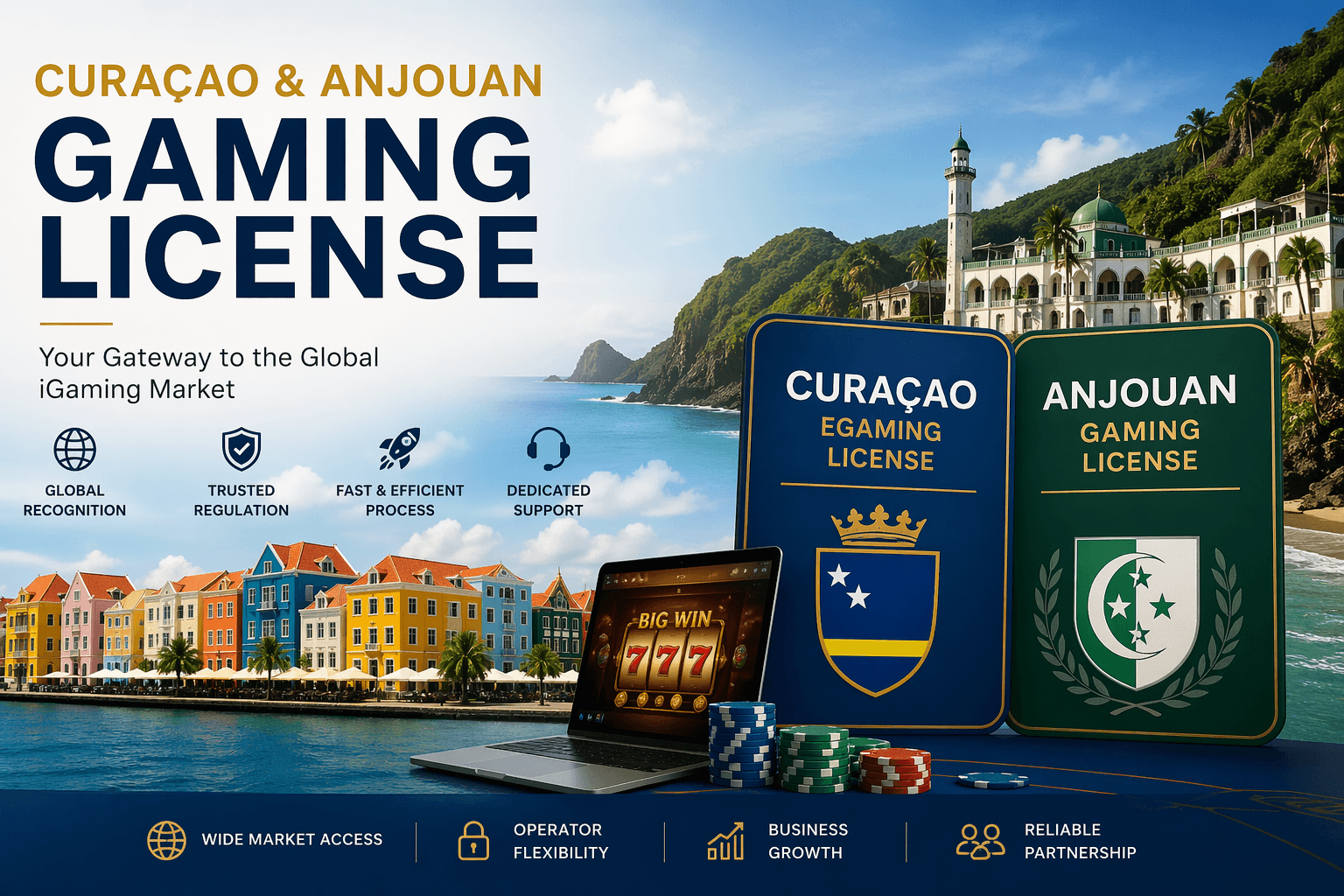
If you're building an online casino, sportsbook, or crypto gambling platform, two jurisdictions come up again and again in early-stage conversations: Curaçao and Anjouan. Both offer accessible offshore gaming licenses with relatively low barriers to entry, but they serve meaningfully different operator profiles. Choosing the wrong one can mean overpaying, facing banking friction, or finding your license isn't accepted in your target markets. This guide breaks down what you actually need to know before committing.
Why Offshore Gaming Licenses Matter
Operating an online gambling business without a license is not only legally precarious — it makes it nearly impossible to open merchant accounts, integrate payment processors, or pass due-diligence checks from software providers. A recognized gaming license signals legitimacy to partners, players, and payment rails alike.
The challenge for early-stage operators is that Tier 1 licenses — Malta, Gibraltar, the UK — come with six-figure costs, lengthy timelines, and strict technical requirements that many startups simply aren't ready for. That's where offshore gaming jurisdictions fill the gap, and why Curaçao and Anjouan have become go-to options for founders looking to launch quickly and cost-effectively.
Before diving into the comparison, it's worth exploring the full range of jurisdictions available to understand where gaming-friendly offshore options sit within a broader structuring strategy.
Curaçao: The Established Offshore Standard
Curaçao has been issuing gaming licenses since 1996, making it one of the oldest and most widely recognised offshore gambling frameworks in the world. The island is an autonomous country within the Kingdom of the Netherlands, which historically gave its licensing regime a degree of European credibility not found in many comparable jurisdictions.
Key Features of a Curaçao Gaming License
Single master license model: Curaçao operates under a master license system where a handful of approved entities issue sub-licenses to operators. This is transitioning to a new direct-licensing framework, so requirements are currently in flux.
Broad game coverage: Sports betting, casino games, poker, and increasingly crypto gambling are all covered under a single license.
International recognition: Widely accepted by payment processors, software providers, and affiliate networks, particularly in emerging markets across Asia, Latin America, and Africa.
Regulatory evolution: Curaçao is actively reforming its framework under the National Ordinance on Offshore Games of Hazard (NOOGH), moving toward stricter compliance requirements. Operators setting up now should expect the new regime to introduce higher standards and costs over time.
Cost and Timeline
Curaçao requires a local entity — typically a Besloten Vennootschap (BV), the Dutch-style private company used in the jurisdiction. Setup costs for a Curaçao BV with gaming license support vary, but you should budget for entity formation fees, licensing application fees (which have increased under the new framework), and ongoing compliance costs. Entity Engine's Curaçao BV formation service covers the entity side of this equation, giving you a properly structured vehicle ready for the licensing process.
Timeline from entity formation to an operational license has historically been 4–12 weeks depending on the sub-licensor, though the new direct-licensing regime may extend this further as the regulator builds capacity.
Anjouan: The Emerging Low-Cost Alternative
Anjouan — one of the islands of the Comoros archipelago in the Indian Ocean — has emerged as a compelling alternative for budget-conscious operators who need a legitimate gaming license without the overhead of Curaçao's reforming regime. The Anjouan Offshore Finance Authority (AOFA) issues gaming licenses directly, creating a simpler, faster, and often more affordable pathway.
Key Features of an Anjouan Gaming License
Direct licensing authority: Unlike Curaçao's sub-license model, Anjouan issues licenses directly through the AOFA, simplifying the process and reducing intermediary costs.
Lower entry costs: Government fees and overall setup costs are generally lower than Curaçao, making Anjouan attractive for lean startups and crypto-native operators.
IBC as the licensed entity: Anjouan licenses are issued to International Business Companies (IBCs) registered in Anjouan, which are lightweight, flexible structures with no local staffing requirements.
Crypto-friendly posture: Anjouan has positioned itself as receptive to Web3 gaming, crypto casinos, and blockchain-based gambling operations — an area where Curaçao's evolving rules are creating uncertainty for some operators.
Developing recognition: Anjouan is newer on the scene, meaning acceptance by major software providers and payment processors is growing but not yet as universal as Curaçao.
Cost and Timeline
Anjouan IBCs are among the most cost-efficient offshore structures available. Entity Engine's Anjouan IBC formation service provides a clear, transparent path to getting your entity in place. Gaming license applications typically process within 2–6 weeks of a complete submission, making Anjouan one of the faster options on the market for operators who need to move quickly.
Head-to-Head Comparison
The table below summarises the key differences between the two jurisdictions across the dimensions that matter most to online gaming operators:
Cost: Anjouan is generally cheaper on both entity formation and government licensing fees. Curaçao costs have risen under the new regulatory framework.
Speed: Both can move quickly, but Anjouan's direct-licensing model can be faster for straightforward applications.
Recognition: Curaçao is more widely accepted by legacy payment processors and established software providers. Anjouan is gaining ground, particularly in crypto-native ecosystems.
Regulatory stability: Curaçao is in transition, introducing new requirements and scrutiny. Anjouan's framework is simpler and currently more stable for new entrants.
Crypto gaming: Anjouan is arguably more accommodating of crypto-first and blockchain-based gaming models. Curaçao permits it but with increasing compliance requirements.
Entity type: Curaçao uses a BV (private company); Anjouan uses an IBC.
Local substance requirements: Curaçao's new regime is introducing more substance requirements. Anjouan currently requires minimal local presence.
Which Jurisdiction Should You Choose?
The right choice depends almost entirely on your operator profile, target markets, and budget constraints.
Reasons you might choose Curaçao:
You are targeting players in markets where Curaçao is already recognised by your payment processor or software provider.
You want the legacy credibility of an established gaming jurisdiction with a longer track record.
You have the budget and compliance appetite to operate under an increasingly regulated framework.
Your business model involves traditional fiat payments and established white-label platforms that require Curaçao licensing.
Reasons you might choose Anjouan:
You are building a crypto casino, blockchain-based gaming platform, or Web3-native gambling product. Founders exploring Web3-specific structures can also review Web3 entity use cases for broader structuring context.
You need to launch fast with minimal upfront costs.
You are comfortable that your key partners — software providers, payment solutions — accept Anjouan licensing.
You want a simpler regulatory environment while your business scales toward a Tier 1 license in the future.
It is also worth noting that some sophisticated operators use a dual-structure approach: an Anjouan IBC for the licensed gaming entity and a separate holding company in a jurisdiction like the BVI or Cayman Islands for IP and investment purposes. This kind of layered structure is something the Entity Engine platform is built to handle — you can explore all available jurisdictions and entity types to model the right combination for your needs.
Compliance and Banking: The Practical Reality
No matter which gaming license you choose, banking remains the hardest problem to solve in the online gambling space. Offshore gaming operators are in a high-risk category for most financial institutions, and your license jurisdiction will directly affect your options.
Curaçao's longer track record means more established relationships with gaming-specialist banks and payment service providers (PSPs). Anjouan operators tend to rely more heavily on crypto payment rails, e-wallets, and specialist high-risk PSPs — which is increasingly viable but requires careful due diligence on partners.
Compliance documentation, KYC/AML policies, and responsible gambling frameworks are expected under both regimes. Cutting corners here creates far greater risk than the licensing fee savings justify. Treat compliance as a non-negotiable cost of doing business, not an optional add-on.
Getting Started
Whichever jurisdiction you choose, the first step is getting the underlying entity properly formed and documented. A sloppy incorporation creates problems downstream — with your license application, your banking, and your cap table if you ever raise investment.
Entity Engine is built to make offshore entity formation fast, transparent, and founder-friendly. Whether you're setting up a Curaçao BV for a gaming license or an Anjouan IBC as your licensed operating entity, the platform gives you clear pricing, streamlined documentation, and support from people who understand the specific requirements of gaming and Web3 business setups.
The online gaming market is competitive, but the structural and compliance layer doesn't have to be a barrier. Get the entity right, choose the license that fits your actual operator profile, and build from a solid foundation.