
EU Inc Explained: What It Means for Businesses in Europe
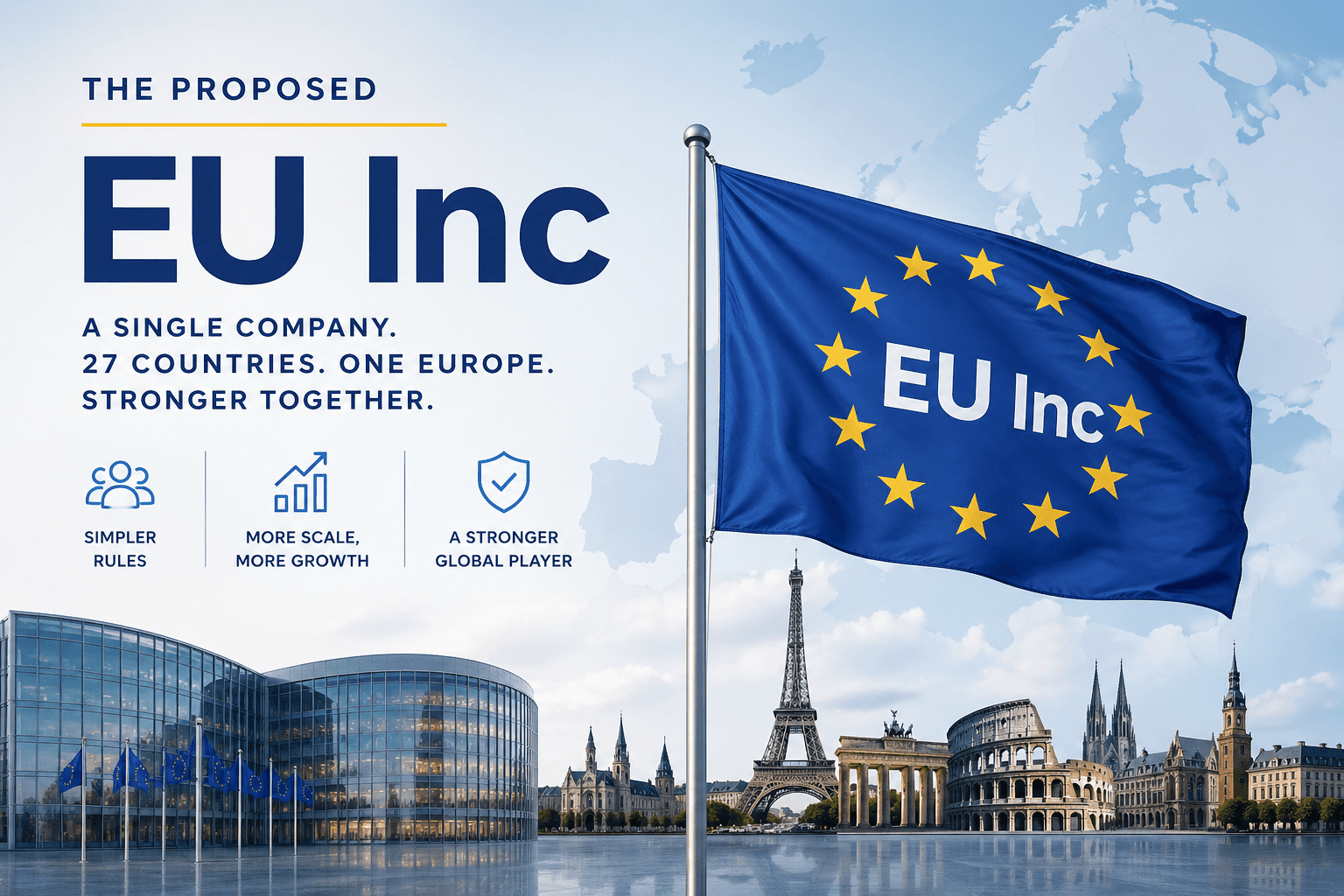
If you have ever tried to expand a business across multiple European Union member states, you already know the problem: 27 different legal systems, 27 sets of incorporation rules, and 27 bureaucracies — each with their own language, timelines, and costs. The proposed EU Inc is the European Commission's attempt to fix that. For founders, operators, and investors with any exposure to the EU market, this proposal deserves careful attention.
What Is the EU Inc?
The EU Inc — formally proposed as the European Company (Societas Privata Europaea) concept revived and modernised — is a draft legal framework that would create a single, standardised private limited company structure usable across all 27 EU member states. Rather than incorporating separately in Germany, France, Spain, and Ireland, a business could form one EU Inc and operate under a unified legal identity throughout the bloc.
The European Commission published its proposal as part of a broader push to reduce the regulatory burden on small and medium-sized enterprises (SMEs) and make the EU a more competitive destination for entrepreneurs. The concept builds on decades of failed or partial attempts — including the Societas Privata Europaea (SPE) directive that was shelved in 2013 — but comes with renewed political will driven by competitiveness concerns in the post-pandemic era.
Key Features of the Proposed Structure
While the legislative text is still moving through European Parliament and Council discussions, the core features of the EU Inc proposal include:
Single registration process: Founders would complete one digital registration through a centralised EU portal, valid across all member states.
Harmonised articles of association: A standard set of constitutional documents, reducing the need for bespoke legal drafting in each jurisdiction.
Low minimum share capital: The proposal targets a minimum share capital requirement of just €1, aligning with modern company law in countries like Ireland and the Netherlands.
Full legal personality in all member states: An EU Inc would be recognised as a legal entity throughout the bloc without needing re-registration or local subsidiaries.
Digital-first operations: Board meetings, shareholder resolutions, and filings would be operable entirely online, removing the need for physical presence in any single state.
Worker participation flexibility: The proposal attempts to balance shareholder flexibility with employee involvement rules, though this remains one of the most contested aspects.
Why Does This Matter for Founders and Operators?
Today, a startup wanting to operate across the EU faces a fragmented landscape. A company incorporated in Spain as a Sociedad Limitada must establish local branches or subsidiaries in other member states to conduct regulated business there. Each subsidiary brings accounting obligations, local directors, filing requirements, and legal fees. The cumulative cost of multi-jurisdiction compliance is a genuine barrier — not just for large corporations, but especially for early-stage companies.
The EU Inc would eliminate much of this duplication. A single entity, registered once, would be able to:
Open bank accounts across the EU under one legal identity
Enter contracts governed by a common framework
Hire employees in multiple member states without creating new legal entities
Access EU procurement and funding programmes under one registration
For operators currently running complex multi-entity structures to cover different EU markets, this could significantly reduce overhead — both financial and administrative.
How Does EU Inc Compare to Existing EU Entity Options?
There are already some pan-European structures available, most notably the Societas Europaea (SE). However, the SE has a minimum share capital of €120,000, requires either a cross-border merger or conversion from an existing company, and was primarily designed for large enterprises. It has seen limited uptake from SMEs for exactly these reasons.
The EU Inc is explicitly designed for smaller, growth-oriented businesses. Its €1 minimum capital and digital incorporation process position it as the EU's answer to the ease of forming a company in jurisdictions like Ireland. For founders already familiar with the Irish Limited Company — one of the EU's most popular incorporation choices for international businesses — the EU Inc would offer similar accessibility but with direct legal recognition across all 27 member states rather than relying on EU freedom-of-establishment principles alone.
Member states like the Netherlands, which hosts a well-established Besloten Vennootschap (BV) structure popular with holding companies and international groups, may see some competitive pressure if the EU Inc gains traction. However, local structures will likely remain relevant for tax treaty purposes and substance requirements for some years yet.
Tax Implications: What the EU Inc Does and Does Not Change
This is where founders need to be precise. The EU Inc proposal is a company law instrument, not a tax harmonisation measure. It does not create a unified corporate tax rate or a single tax residency across the EU. Corporate tax will still be determined by where the company has its registered office and where it has substance — which will continue to vary significantly between member states.
Countries like Cyprus and Malta will likely remain attractive EU incorporation locations with their own competitive corporate tax regimes. A Cyprus Ltd or a Malta Ltd may still offer more tailored tax positioning than a generic EU Inc registered in a higher-tax member state. The EU Inc changes the legal operating environment; tax structuring remains a separate, jurisdiction-specific exercise.
This is also relevant for web3 and digital asset businesses navigating the EU regulatory environment. If you are thinking about how EU company law interacts with frameworks like MiCA, it is worth reading our breakdown of what EU MiCA means for Web3 projects.
What Are the Risks and Open Questions?
The EU Inc proposal is not without critics or complexity. Several issues remain unresolved as the text moves through the legislative process:
Worker codetermination: Germany and several northern European states have strong traditions of employee board representation. Negotiating how this applies to a supranational structure has been contentious.
Risk of regulatory arbitrage: Critics worry that companies will register EU Incs in low-regulation, low-tax member states while operating primarily elsewhere — the same concern that surrounds existing national structures today.
Timeline uncertainty: The proposal still needs to complete the full EU legislative cycle. Estimates for a final text and member state transposition range from 2026 to 2028 at the earliest.
Local professional services dependency: Even with harmonised documents, local legal and tax advice will still be necessary. The EU Inc reduces friction; it does not eliminate the need for structured guidance.
What Should Founders Be Doing Now?
The EU Inc is not yet law, and its final form may differ materially from the current proposal. That said, founders and operators with European ambitions should not wait passively. There are practical steps worth taking now:
Map your current entity structure across EU jurisdictions and identify where consolidation could reduce cost and complexity.
Monitor legislative progress through European Parliament updates — the proposal is moving, and the timeline for transposition could accelerate.
Evaluate interim structures: If you need EU market access now, existing member state options remain the practical path. Ireland, the Netherlands, Cyprus, and Malta each offer well-worn routes for international businesses.
Plan for flexibility: Whatever structure you choose today, ensure your constitutional documents and shareholder agreements allow for future conversion or migration if the EU Inc becomes available and beneficial.
Understanding which jurisdictions and structures are available across the full range of global incorporation options is a good starting point for mapping your options — whether you are waiting for the EU Inc or building your structure today.
The Bigger Picture: A More Competitive European Union
The EU Inc sits within a wider European effort to close the competitiveness gap with the United States and, increasingly, with Asia-Pacific hubs like Singapore. The Draghi report on EU competitiveness, published in late 2024, made clear that regulatory fragmentation is one of the single biggest structural disadvantages facing European businesses. The EU Inc is one of the more concrete responses to that diagnosis.
For founders building internationally, this is a signal worth tracking. A Europe where a single company structure gives you legal standing in 27 markets would be a meaningfully different operating environment — not perfect, and still requiring professional structuring advice, but substantially less burdensome than today.
If you are thinking through your European or global entity strategy, explore the use cases that match your business model and see how modern incorporation platforms are making this process faster and less painful than it used to be.
Conclusion
The proposed EU Inc is one of the most significant company law reforms the European Union has attempted in a generation. It will not solve every problem — tax, substance, and employment law will remain fragmented — but it has the potential to dramatically lower the barrier to pan-European company formation for SMEs and growth-stage businesses. Watch the legislative timeline closely, audit your current structure, and position yourself to act when the framework arrives.