
Why a Cayman Foundation Works for China, HK, UK & US
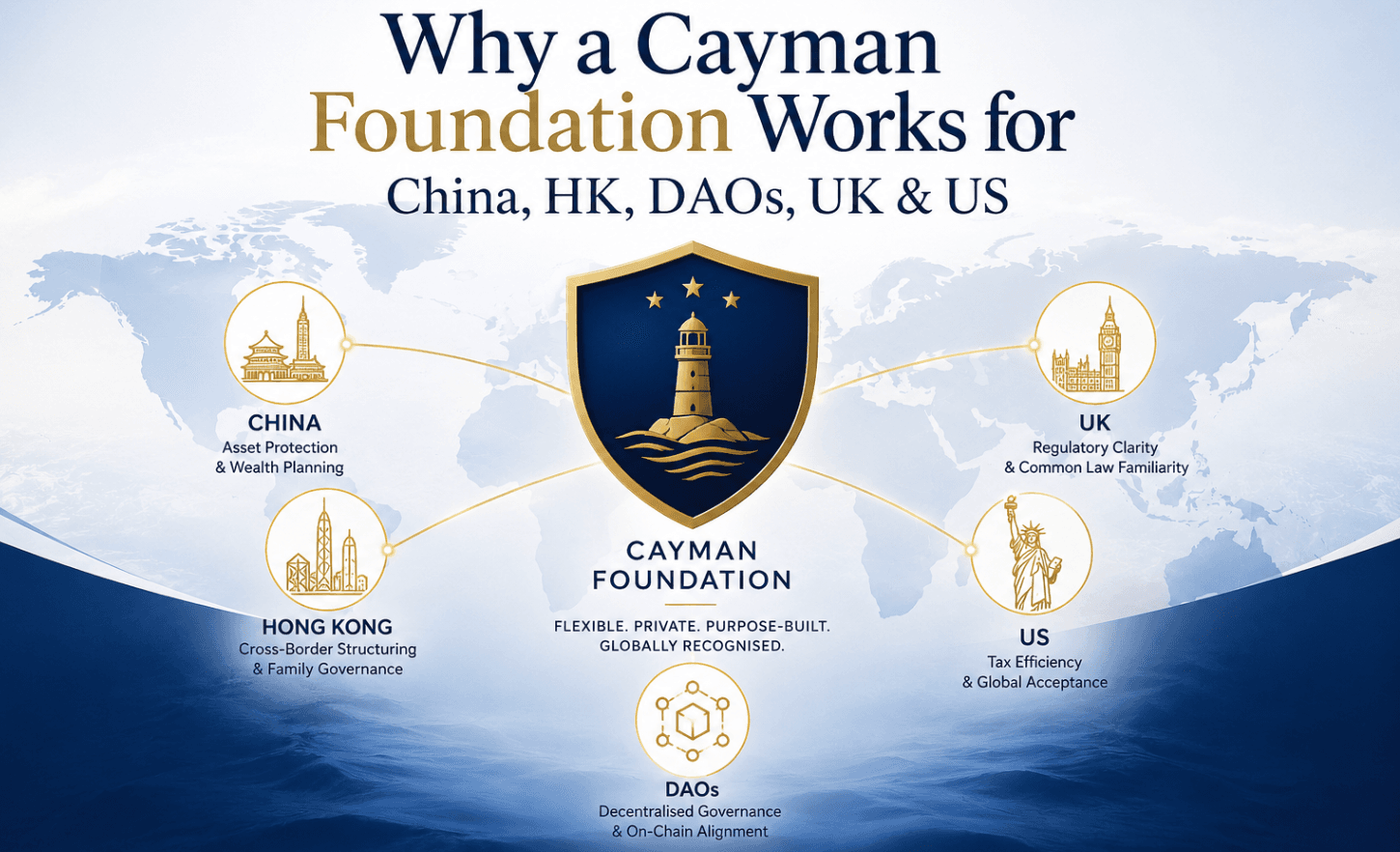
If you're a founder, operator, or DAO contributor trying to build something global, you've probably spent far too long debating which entity structure actually fits your situation. The Cayman Foundation Company rarely gets explained clearly — yet it quietly serves a remarkably diverse audience: mainland Chinese entrepreneurs navigating capital controls, Hong Kong operators seeking international credibility, web3 teams building decentralised protocols, and founders in the UK, Europe, and the USA who want an offshore structure that won't attract a regulatory frown. Here's why it works so well for all of them.
What Is a Cayman Foundation Company?
The Cayman Foundation Company is a unique hybrid structure established under the Cayman Islands Foundation Companies Act 2017. It combines the legal personality and limited liability of a company with the purpose-driven, non-ownership characteristics of a foundation. Unlike a trust, it holds assets in its own name. Unlike a traditional company, it has no shareholders — only beneficiaries or purposes it serves. A Supervisor (optional but common) provides an additional governance check.
This combination makes it extraordinarily flexible. It can hold assets, enter contracts, issue tokens, govern a protocol, or act as a family wealth vehicle — all within the same legal wrapper. You can read a detailed breakdown in our guide to the Cayman Foundation Company structure.
Why It Works for Founders and Families from China
Mainland Chinese entrepreneurs face a distinctive set of challenges when structuring internationally. Capital controls, the complexity of China's CRS reporting obligations, and the desire to hold assets outside the domestic system all push sophisticated operators towards offshore structures. The Cayman Foundation Company addresses several of these concerns at once.
No shareholders on the register. The foundation has no shareholders, which means there is no obvious equity trail linking a Chinese national to an offshore vehicle in the way a BVI or Cayman company structure would.
Purpose-driven ownership. Assets can be held for a defined purpose — business development, family benefit, philanthropy — without requiring named beneficial owners in the traditional sense.
Internationally respected. The Cayman Islands are on no major blacklist and are well understood by global banks, making it far easier to open accounts and engage institutional counterparties.
Estate and succession planning. For high-net-worth families, the foundation can hold operating companies, real estate, and digital assets across generations without triggering forced heirship rules.
For those considering complementary structures in the region, a Hong Kong Limited Company is often used alongside a Cayman Foundation as the operating entity, with the foundation sitting above it as the holding layer.
Why Hong Kong Operators Choose It
Hong Kong has long been a gateway between East and West, and its sophisticated business community understands offshore structuring better than almost anywhere else. For HK-based operators, the Cayman Foundation offers a clean separation between the operating business in Hong Kong and the ownership or governance layer offshore.
This matters for several reasons. First, Hong Kong's beneficial ownership regime has been tightening. Holding operating assets in a Cayman Foundation creates a legitimate offshore governance layer that reduces exposure to local regulatory creep. Second, for web3 and digital asset businesses — a major and growing sector in Hong Kong — the foundation structure enables token issuance, DAO governance, and protocol ownership without the legal ambiguity that comes with a standard limited company. If you're exploring token structures, our guide to the best jurisdictions for token issuance vehicles in 2026 covers how the Cayman Foundation compares to alternatives.
Why DAOs Love the Cayman Foundation
Decentralised Autonomous Organisations face a fundamental legal problem: they are stateless by design, but the real world demands legal personality. Smart contracts don't sign bank accounts. Protocols can't enter vendor agreements. Contributors can't receive grants without a legal entity.
The Cayman Foundation Company has emerged as the leading solution to this problem, and for good reason:
No shareholders or members. DAOs don't have traditional equity holders — and the foundation mirrors that by having purposes rather than owners.
On-chain governance compatible. The foundation's governing documents can reference token-holder votes and smart contract outputs as binding governance mechanisms.
Supervisor role. A Supervisor can be appointed to act as a safeguard, ensuring the foundation acts in accordance with its stated purposes — a role easily filled by a multi-sig or a trusted third party.
Token issuance. The foundation can lawfully issue tokens, hold a treasury, and distribute grants — giving the DAO a fully legal operational layer.
For a deeper look at how web3 teams are deploying this structure, see our detailed post on the Cayman Foundation for Web3: Pros, Cons and Setup Guide.
Why It Works for UK and European Founders
UK and European founders often assume they need to keep everything onshore — a UK Ltd, a German GmbH, or a Dutch BV. But for internationally active businesses, holding companies, and digital asset ventures, the Cayman Foundation offers a compelling offshore layer that is entirely legal and widely used.
The UK's controlled foreign company (CFC) rules and Europe's anti-avoidance frameworks mean you need to be thoughtful about how you structure things, but the Cayman Foundation is not the wild west. It has substance requirements, is well understood by HMRC and European tax advisers, and provides a clean, neutral governance vehicle for international projects.
For European founders who want a complementary onshore entity, structures like an Irish Limited Company or a Dutch entity work naturally alongside a Cayman Foundation in a layered structure. The EU's evolving MiCA framework is also worth understanding if you're operating in the digital assets space — our EU MiCA explainer breaks down what web3 projects need to know.
Why US Founders and Operators Use It
American founders face some of the strictest offshore reporting requirements in the world — FBAR, FATCA, and the IRS's PFIC and CFC regimes all create complexity. Despite this, the Cayman Foundation remains popular among US operators, particularly in the web3 space, because it solves structural problems that US entities simply cannot.
A US-based founder building a globally decentralised protocol cannot use a Delaware C-Corp as the governance entity — it creates US nexus for the entire protocol. A Cayman Foundation, structured correctly and with proper US tax advice, allows the protocol's governance and treasury to sit offshore, with US contributors participating as individuals or through separate US entities. Many teams pair a Delaware C-Corp for their US-facing operations with a Cayman Foundation governing the broader protocol — a structure used by some of the largest DeFi projects in the world.
Key Benefits at a Glance
No shareholders — ideal for DAOs, family offices, and purpose-driven vehicles
Internationally recognised — accepted by major banks and institutional partners
Purpose-flexible — can hold companies, tokens, real estate, and digital assets
Governance-ready — compatible with on-chain voting and multi-sig arrangements
Neutral jurisdiction — no territorial bias, useful for cross-border teams
Privacy — no public register of beneficiaries or purposes
Getting Started
The Cayman Foundation Company is one of the most versatile structures available to founders, families, and decentralised teams today. Whether you're based in Shenzhen, Hong Kong, London, Berlin, or San Francisco, it can play a central role in how you hold assets, govern a protocol, or protect generational wealth.
If you're ready to explore which structure fits your specific situation, our use cases library covers the most common scenarios in depth — or explore the full range of jurisdictions supported by Entity Engine to see how the Cayman Foundation fits into a broader multi-entity strategy.